
By: Montage Technology
The promise of memory disaggregation has moved from concept to reality. Montage Technology has successfully demonstrated a fully functional CXL® Dynamic Capacity Device (DCD) system using our new CXL 3.2 x8 memory expansion controller chip, showcasing how DCD technology with Multi-Head Device (MHD) support enables memory pooling and sharing across multiple hosts. This live demo proves the technology is ready for deployment today.
From Static to Dynamic: The Memory Revolution
Traditional server architectures lock memory capacity to individual systems, creating inefficiencies where some servers sit with idle RAM while others desperately need more. CXL DCDs fundamentally change this model by allowing memory to be dynamically allocated and released between hosts in response to real-time demand, transforming memory into a fluid, shared resource that flows where needed most.
System Architecture: Production-Ready Components
The demonstration system brings together the complete DCD memory pooling stack, as shown in the figure below:
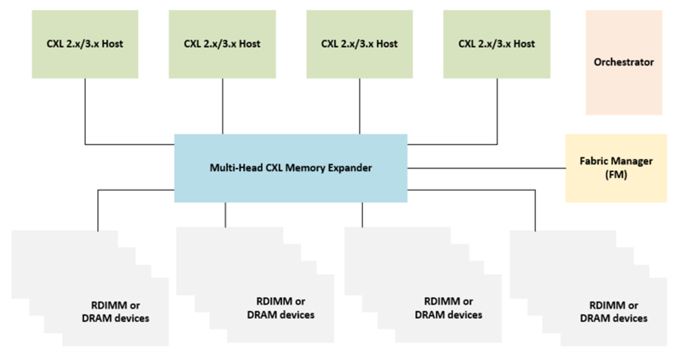
Demonstration System Architecture
Hardware: Montage’s CXL 3.2 memory expansion controller on an AIC evaluation board, bifurcated into dual Gen6 x4 ports connecting two CXL 2.x/3.x hosts. The multi-head controller supports both RDIMM and DRAM device in the down application without RCD, enabling flexible deployment while remaining compliant with the specification.
Software: A Fabric Manager on a BMC-like platform and an Orchestrator coordinate the system. Each host runs a Linux kernel with DCD patches (https://github.com/weiny2/linux-kernel/tree/dcd-v6-2025-09-23), enabling seamless communication through standard CXL APIs. The MHD firmware handles dynamic capacity management transparently.
Live Demonstration: Dynamic Memory in Action
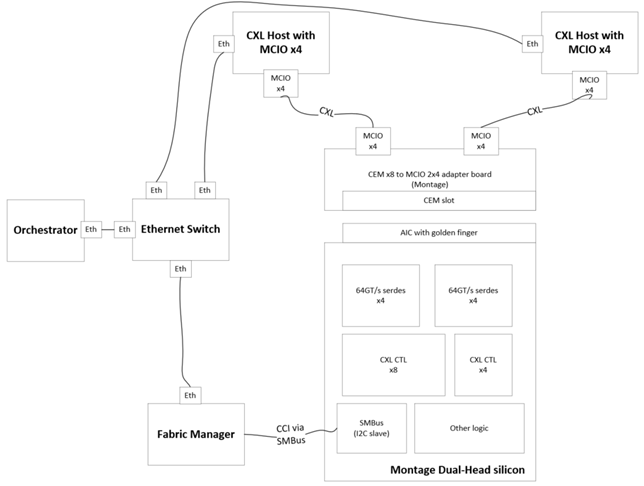
Dual-Host System Demonstration Setup Diagram
Note: Although the demo shows a dual-host system, users can deploy a multi-host system by intertwining two hosts per CXL Memory Controller. We shared a diagram for reference below.
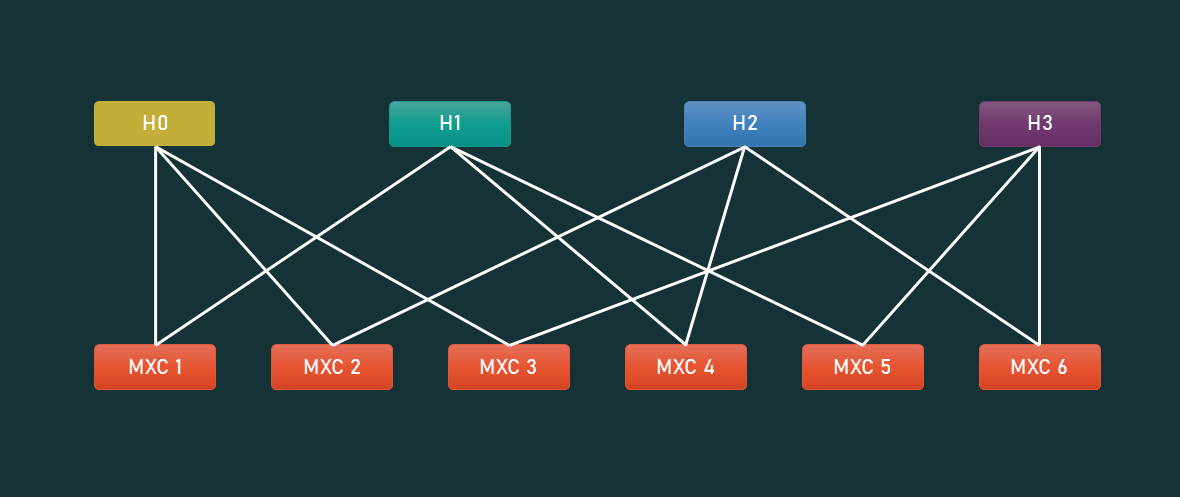
Figure adapted from Yuhong Zhong, Fiodar Kazhamiaka, Pantea Zardoshti, Shuwei Teng, Rodrigo Fonseca, Mark D. Hill and Daniel S. Berger, “Octopus: Enhancing CXL Memory Pods via Sparse Topology,” arXiv:2501.09020v3, 2026
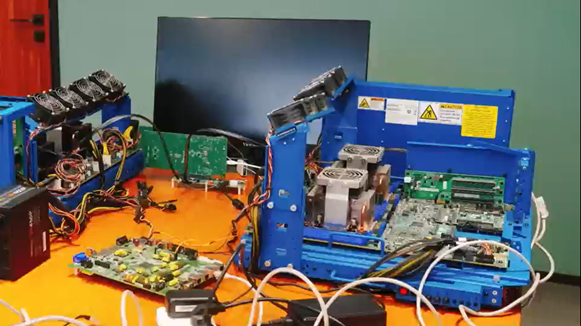
A Photo of the Demo System
The dual-host system demonstration setup is illustrated in the diagram above, while the photo shows our actual hardware configuration. The Orchestrator continuously monitors the memory resource status of all managed hosts and their actual application demands, and dynamically allocates memory to or releases memory from each host through the Fabric Manager. The demonstration showcased DCD operations through a five-step sequence of dynamic capacity additions and releases across two hosts.
Step 1: Initial Capacity Addition to Host 1
Host 1, originally equipped with 64GB DDR, received an 8GB extent (Extent 0, start device address = 400,000,000, length = 200,000,000). The system immediately recognized the additional capacity, expanding total memory to 72GB without a restart.
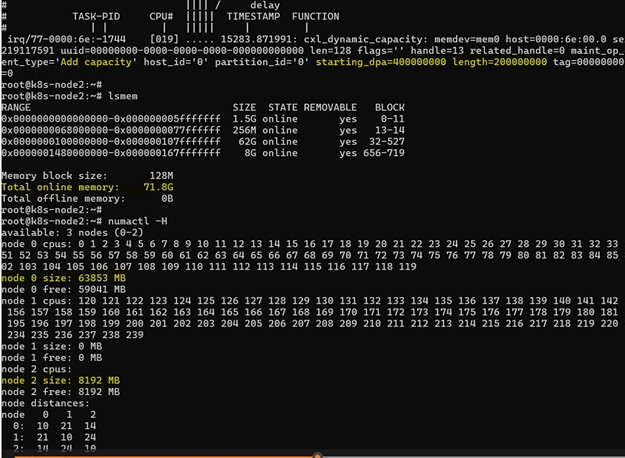
Screen 1: Host 1 Memory Expansion from 64GB to 72GB – Extent 0 Addition
Step 2: Second Capacity Addition to Host 1
The Orchestrator added another 8GB extent (Extent1, Start device address = 600,000,000, length = 200,000,000) to Host 1, expanding total memory to 80GB. This demonstrates incremental memory scaling based on workload demands.
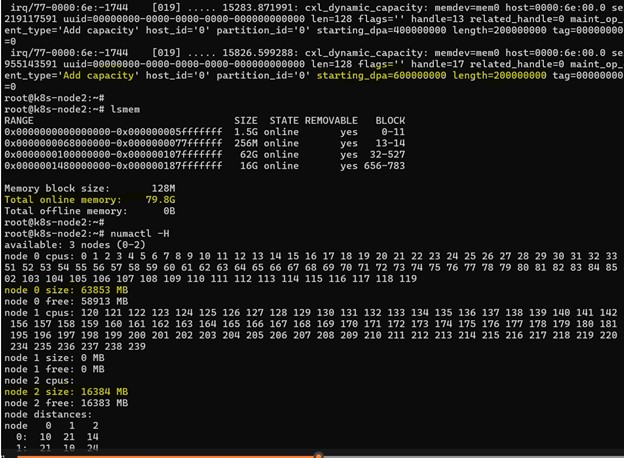
Screen 2: Host 1 Memory Expansion from 72GB to 80GB – Extent 1 Addition
Step 3: Selective Capacity Release from Host 1
The Orchestrator released Extent 1 (8GB) from Host 1 and returned it to the shared pool. The total memory on Host 1 was adjusted to 72GB, freeing capacity that is now available for other hosts, without impacting running workloads.
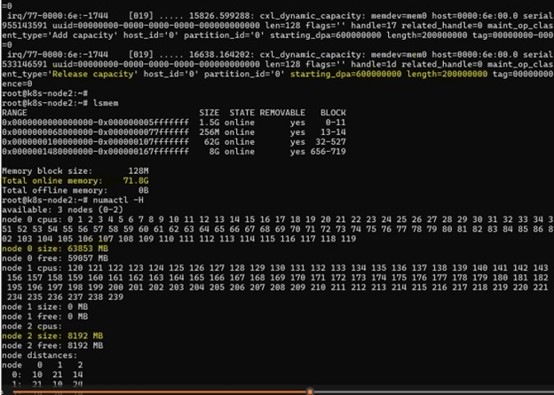
Screen 3: Host 1 Memory Reduction from 80GB to 72GB – Extent 1 Release
Step 4: Complete Dynamic Capacity Release from Host 1
The Orchestrator released Extent 0 (8GB), returning Host 1 to its 64GB baseline. This demonstrates clean memory reclamation without residual allocations.
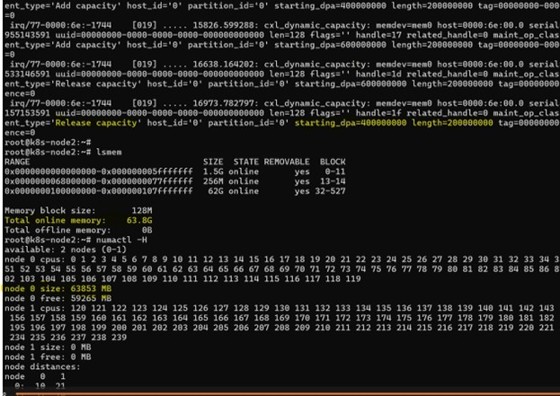
Screen 4: Host 1 Memory Reduction from 72GB to 64GB – Extent 0 Release
Step 5: Cross-Host Memory Allocation
The Orchestrator allocated another 8GB extent to Host 0 (initially 32GB DDR), demonstrating true memory pooling with resources flowing between hosts based on demand rather than static provisioning.
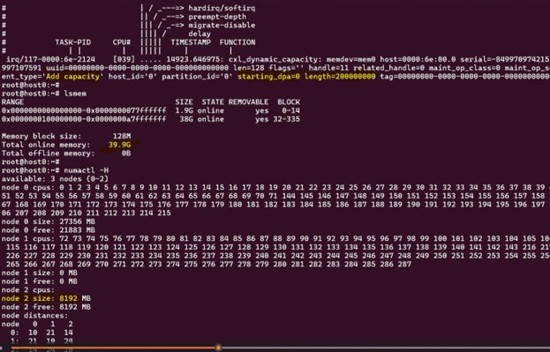
Screen 5: Host 0 Memory Expansion from 32GB to 40GB – Multi-host Pooling
The demo validates that DCD enables true memory elasticity: capacity can be added incrementally and released selectively without downtime.
What This Means for the Industry
Montage’s demonstration validates that DCD technology is available and deployable today. The system runs on a CXL 3.2 silicon with mature software support, proving memory disaggregation can integrate into existing data centers. This enables more efficient resource allocation, improved performance, and lower TCO, particularly beneficial for AI and ML applications with unpredictable memory demands. Montage is expanding this demonstration to include DCD-based memory sharing, where hosts actively share memory regions for collaborative workloads.
The future of data center memory is dynamic, disaggregated, and efficient.
Learn More:
- DCD Add/Release Capacity Demo Video
- More information about Montage’s CXL memory expansion controller: https://www.montage-tech.com/MXC.