
At SC26, Penguin Solutions will demonstrate how Compute Express Link® (CXL®) can give existing DDR4 memory a new role in next-generation server infrastructure. The premise is simple: during a server refresh, the platform often reaches end of service before its memory does. Although DDR4 cannot be installed directly in a DDR5 memory channel, a CXL memory controller can bridge that generation gap and present the reclaimed media to the host as additional capacity.
The demonstration will feature SMART’s CXA-8F2W-D4, a CXL Add-In Card operating in an Intel® Xeon® 6-based server. The CXL 2.0 Type 3 AIC connects through PCIe Gen5 x16 and uses an onboard controller to translate CXL.mem transactions into DDR4 commands. Its four memory channels support up to eight qualified DDR4 RDIMMs at speeds up to DDR4-3200. A configuration with eight 64 GB RDIMMs provides 512 GB of CXL-attached capacity.
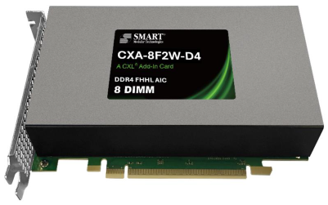
This approach addresses an important data center challenge: expanding memory capacity while extracting additional value from existing infrastructure investments. Rather than retiring usable DDR4 during server refresh cycles, organizations can screen and qualify those assets for deployment as CXL-attached memory. That capacity is useful only if the reclaimed modules are suitable for another deployment. Penguin Solutions supports the process from inventory review through visual inspection, functional testing, system-level screening, installation, and final full-card validation. The result is a tested assembly rather than a collection of individually checked parts. As part of this process, reused DDR4 RDIMMs undergo Zefr screening to identify weak modules before installation, followed by validation of the fully populated CXL AIC.
Target use cases include workloads that need more capacity but can tolerate a tier slightly below local DDR5: AI inference state and KV cache, large databases, analytics, and HPC applications with large working sets. Local DDR5 remains the near tier for the hottest data, while CXL-attached DDR4 provides a larger capacity tier on the same host.
At SC26, attendees can see a mechanical sample of the CXA-8F2W-D4 alongside the target server platform in the CXL Consortium booth and learn how the proposed solution is designed to reclaim qualified DDR4 as CXL-attached capacity. The demonstration will focus on the hardware concept, planned architecture, Zefr module-screening process, intended use cases, and path toward system qualification. Attendees can also visit the Penguin Solutions booth to discuss CXL memory expansion products and deployment options.
Why it matters: CXL can do more than add memory. It can bridge server generations, preserve the value of customer-owned DDR4, and reduce dependence on new-module purchases when supply, lead times, or budget constrain expansion. Reuse is not appropriate for every module, chassis, or workload, but when the inventory, platform, and application align, it offers a practical path to extend infrastructure value.
Visit the SC26 demos in the CXL Consortium booth (no. 1218) and the Penguin Solutions booth (no. 1723) to explore DDR4 memory reuse, CXL-attached capacity, and potential pilot deployments. Learn more about Penguin Solutions CXL memory products.